


Verona in a Glass: Valpolicella, Ripasso, Amarone & an enchanting weekend in the city of love

We spent last weekend in wonderful Verona. We walked the city, we drank spritz for six euros and of course, some incredible wine. Oh, and we visited loads of stunning churches! The weekend inspired us to record a few notes from our break, the wine we drank, where we stayed and some recommendations for anyone planning a visit to the romantic UNESCO World Heritage Site.

Priorities. First up, lets talk about the region's wine.
Few wine regions tell a story quite like the hills surrounding Verona. Many arrive for Roman history, opera and Shakespearean romance, wine lovers come for some of Italy's most fascinating and distinctive red wines.
A highlight from our time in Verona was a visit to Cantine Giacomo Montresor, where Edoardo Montresor shared the story of his family's remarkable connection to Verona and the wines of Valpolicella. Understanding that history helps explain why wines such as Valpolicella, Ripasso and Amarone have become some of Italy's most celebrated exports.
Where is Valpolicella?
Valpolicella lies immediately north-west of Verona, stretching through a series of valleys between the city and the foothills of the Alps. The region's combination of limestone-rich soils, cooling mountain influences and warm Venetian sunshine creates ideal conditions for growing red grapes.
The Grapes Behind the Wines
The wines of Valpolicella are blends rather than single-varietal wines.
Corvina – the backbone of the blend, bringing cherry fruit, structure and elegance.
Corvinone – once considered a form of Corvina but now recognised as a separate variety, adding body and spice.
Rondinella – valued for colour, floral notes and reliability in the vineyard.
Small percentages of other authorised local varieties may also be included under DOC and DOCG rules.
Valpolicella, Ripasso and Amarone: What's the Difference?
One grape blend. Three very different expressions.
Valpolicella DOC
Valpolicella is the region's classic red wine and often the starting point for understanding the region. Typically light to medium-bodied, it showcases fresh sour cherry, red berry and floral notes with lively acidity. It is a wine made for food and everyday enjoyment, pairing beautifully with pasta, cured meats and pizza.
Ripasso della Valpolicella DOC
Ripasso occupies the middle ground between Valpolicella and Amarone.
After Amarone has completed fermentation, the remaining grape skins are added to a finished Valpolicella wine for a second fermentation. The term ripasso literally means "re-passed."
This process gives the wine:
Greater body
Richer dark fruit flavours
Additional spice and complexity
Softer tannins
The result is often described as "baby Amarone" — offering some of Amarone's richness while retaining Valpolicella's freshness.
Amarone della Valpolicella DOCG
Amarone is the region's flagship wine and one of Italy's most distinctive reds. If I'm being completed honest, I'd forgotten quite how good it is.
Before fermentation, grapes are laid out to dry for several months in special drying lofts known as fruttai. This traditional process, called appassimento, concentrates sugars, flavours and aromas.
The resulting wine is powerful yet elegant, delivering layers of:
Dried cherry
Fig and raisin
Dark chocolate
Tobacco
Spice
Despite its richness, great Amarone maintains remarkable balance and freshness.
Beyond Amarone: Other Wines Worth Discovering
During our trip we tried all of the other local signature wines.
Soave
My go to white wine during our trip. East of Verona lies the famous Soave region, producing elegant white wines primarily from the Garganega grape. Expect citrus, almond and mineral notes that pair beautifully with seafood and lighter dishes.
Lugana
I only enjoyed half the Lugana's I tried but if you're a Sauvignon Blanc fan, then this is probably the one for you. Near the southern shores of Lake Garda, Lugana produces refined whites made from Turbiana grapes. These wines combine freshness, texture and remarkable ageing potential.
Bardolino
Produced on the eastern shores of Lake Garda, Bardolino offers lighter, vibrant reds that are perfect for warm-weather drinking and local cuisine. Good but give me the Valpoliclla.
Recioto della Valpolicella
Considered Amarone's historic ancestor, Recioto uses the same dried grapes but fermentation is stopped early, leaving natural sweetness. The result is a luscious dessert wine packed with dried fruit, chocolate and spice.
A Visit to the Montresor Family
One of the highlights of our trip was spending time at Cantine Giacomo Montresor with Eddy Montresor and learning about the family's long connection to the region.
The Montresor story stretches back to the 1600s, when the family left the Loire Valley in France and settled near Verona in the countryside around Bussolengo. The winery itself was formally established in 1892 when Gaetano Montresor purchased a small cellar and named it after his son, Giacomo.
Over the following decades, the family helped bring Veronese wines to international markets. One particularly fascinating chapter came in the early twentieth century, when Giacomo developed the distinctive satin-finished bottle that became a Montresor hallmark. The design was intended to better protect wine during long ocean voyages to North America, where demand for Veronese wines was growing.
Today, the winery remains deeply connected to the identity of Verona and Valpolicella. We'd highly reccommend a visit so you can explore the family's Wine Museum, which traces more than 130 years of history while explaining the traditions of appassimento and the development of Amarone. Plus the tasting of course!
You will absolutely see some of their wines feature in our upcoming events.
Why Valpolicella Matters
Valpolicella is one of those rare wine regions where tradition, geography and innovation intersect beautifully. From the bright freshness of a young Valpolicella to the layered richness of Ripasso and the extraordinary depth of Amarone, the wines tell the story of the land from which they come.
After visiting Verona and seeing the vineyards, drying lofts and cellars firsthand, it becomes clear that these wines are more than labels on a bottle. They tell a story of of history, family heritage and a landscape that remains one of Italy's greatest wine treasures.
Where did we stay?
Just a couple of miles from the Montresor winery (and a 22 euro cab ride from central Verona), we stayed at the Delser Manor House, which we loved.
Perched above Verona among vineyards and olive groves, the Delser Manor House feels less like a hotel and more like a living piece of the region's history. Built within what was once a Roman water cistern and standing on land linked to Benedictine monks for over a millennium, it perfectly reflects the way Verona blends ancient heritage with modern hospitality.
This hotel has a bar and a pool but no restaurant. The owner, Alberto, is a legend. He detected my diluted Thames Estuary accent in an instant, having spent 18 months living in Kent during the eighties. He was always on hand for anything we needed and even gave us a lift to the winery and then into town that day, offering some fantastic recommendations for sightseeing and refuelling.
Although we booked via Booking.Com, Alberto recommends booking direct for the best prices. Delser Manor House
Sightseeing
Three hour walking tour with Walks in Europe £60 per person
We spent a morning exploring the historic heart of Verona on a guided walking tour, which gave us a great introduction to the city's history and culture. The tour guide had lived in Verona all her life and was excellent.
The tour began at Verona's famous Roman Arena, where we learned about its origins and the role it played in Roman life nearly 2,000 years ago. From there, we wandered through Piazza Bra and the city's network of charming streets before arriving at Piazza delle Erbe, the historic marketplace that remains one of Verona's liveliest and most picturesque squares.
One of the highlights was taking the funicular up to Saint Peter's Hill, where we were rewarded with stunning views across Verona's terracotta rooftops, church towers and the winding Adige River.
We had upgraded the guided tour ticket, to include a visit to Juliet's House which you do independently, stepping into the courtyard and seeing the famous balcony associated with Shakespeare's Romeo and Juliet. This is very touristy of course but Lucy had made me watch Letters to Juliet to get us in the mood for Verona so felt we couldn't miss it. It's said to be good luck to touch the bronze breasts of Juliette in the courtyard so Lucy obliged and appeared on the balcony so I could take a picture from below.
Verona Four Church Circuit
We love to visit old places of worship for the incredible architecture (it's not all drinking wine in the sunshine) and Verona’s "Four Churches" circuit is an excellent way to explore the city's rich religious and architectural history. You can access all four historic churches using a single ticket (just €8) or using the city-wide VeronaCard, which we didn't buy but heard is a great way to gain access to the city's tourist spots.
The four churches included in the pass are:
Basilica di San Zeno Maggiore: Considered a masterpiece of Italian Romanesque architecture. Look for the stunning rose window ("Wheel of Fortune"), the intricate bronze doors, and Andrea Mantegna’s famous altarpiece inside.
Basilica di Santa Anastasia: The largest church in Verona, built in the Italian Gothic style. It features an impressive interior with massive red Verona marble columns and Pisanello's famous fresco of Saint George and the Princess.
Chiesa di San Fermo Maggiore: A unique complex made up of two superimposed churches—a Romanesque lower church and a Gothic upper church with an extraordinary wooden hull ceiling.
Cathedral Complex (Duomo di Verona): Known as Santa Maria Matricolare, this complex includes the Duomo (featuring stunning Romanesque-Gothic architecture and red marble columns), the ancient Church of Sant'Elena, and the Baptistery of San Giovanni in Fonte.
The cumulative ticket can be purchased at any of the four churches and they were all breathtaking. Visit Verona.
Castelvecchio Bridge and Museum
We planned to visit the Castelvecchio Museum but only managed to see the bridge. Worth noting that the museum is not open on a Monday!
The Complex
The Bridge (Ponte Scaligero): A striking fortified red-brick bridge featuring majestic turrets and battlements. Built in 1354 as an escape route for the ruling Scaliger family, it was famously blown up during WWII and meticulously reconstructed stone by stone.
The Museum (Museo di Castelvecchio): Housed inside the castle, this is Verona's most important art museum. It boasts 29 rooms filled with medieval and Renaissance paintings, sculptures, ancient weapons, and ceramics. The museum's interior is a masterpiece in itself, uniquely renovated by the renowned 20th-century architect Carlo Scarpa.
The bridge is impressive in itself but we're told the museum is also unmissable, unless you are us. Both are a short walk from the Basilica di San Zeno Maggiore on the four-church-circuit. Castelvecchio Tickets are just eight euros.
Eating and drinking
Piazza Bra
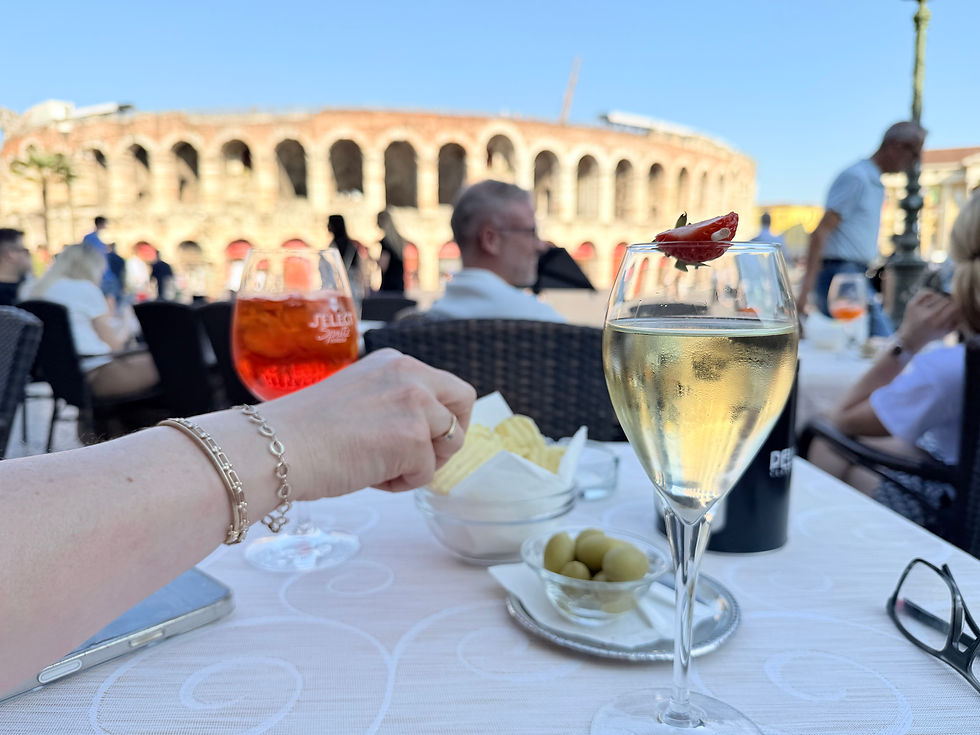
Any trip to Verona must surely include taking in a drink and the view at Piazza Bra. Piazza Bra, often simply called The Bra, is the largest public square in Verona, Italy, situated in its historic city center. The name "Bra" derives from the word braida, a term rooted in the Lombardic word breit, meaning 'wide' or 'broad'. We were told that this is a great place for a drink but best to dine elsewhere for quality and value. That made sense to us.
Antica Bottega del Vino
Antica Bottega del Vino is one of the city's most iconic wine destinations. Hidden away in the historic centre, this atmospheric wine tavern has been serving locals and visitors for generations and is renowned for its extraordinary wine list, particularly its selection of Amarone and Valpolicella wines.
Founded in 1890, though wine has reportedly been served on the site since the 1500s, it is considered one of Italy's most historic wine taverns. Over the centuries it evolved from a traditional osteria into one of the country's most respected wine destinations, attracting everyone from local winemakers to international wine collectors
This was our favourite spot for cicchetti, with fairly priced small plates served from the bar top. Disappointingly service was not particularly friendly here but the food and wine were excellent and we were still pleased to visit. Antica Bottega del Vino
Hosteria Il Punto Rosa
One of our favourite wine stops in Verona was at Hosteria Il Punto Rosa, a cosy restaurant tucked away on a side street just a short walk from the Arena. Known for its traditional Veronese dishes and strong local wine list.
We had a lovely evening here, basking in heat, drinking through their wines by the glass and on our second visit, enjoying some cicchetti. The manager Helena was great at talking us through the wines and correcting me on my Italian pronounciation.
Whilst we couldn't bring ourselves to sit inside on such a balmy summer's night, it was a wonderfully cosy little spot and would be the perfect location for a romantic dinner. Hosteria Il Punto Rosa.
Oreste Cantina Dal Zovo
We actually stumbled across this one after being lured towards another beautiful looking bar, Romeo Bistrot and Bar. We should have known better than head to a bar in the central tourist area named after Romeo and Juliet, but we were only planning a drink and their wine by the glass list looked good. We'd walked straight past the subtle, almost hole in the wall, Oreste Cantina Dal Zovo. After being ignored for some time and then seeing numerous other tables waiting for drinks and food, we decided to hot step back down the hill a few steps to this spot, and we're so pleased we did!
Oreste Cantina Dal Zovo, is a historic enoteca tucked away near the famous Pozzo dell'Amore (Well of Love) in the heart of the city. Founded in 1958, it has the feel of a classic old-world wine bar, with shelves packed with bottles, historic interiors and a strong focus on both local and international wines. Obviously, we were only interested in the local stuff!
What we loved most was its authentic character, it was like an antique wine library. Unlike some of the larger wine venues in Verona, Dal Zovo feels intimate and timeless. It was scattered with locals grabbing a glass of Amarone. Oreste Cantina Dal Zovo.
Osteria Verona Antica
Almost didn't include this one. Excellent food, incredible views and awful service. Their location means they will be busy anyway but service was clumsy and drinks arrived after the food, albeit quickly when they reaslised the drinks had been missed. It was after being called back when they thought we were doing a runner having already paid the bill that left a particularly bad taste. Nevertheless, there are other restaurants on this stretch and I would recommend stopping nearby for food overlooking the Adige river. Osteria Verona Antica.
Verona, a must visit European City Break
We had a fantastic time in Verona and highly recommend it, particularly as it's so easy to reach from Birmingham. Service was more hit and miss that anywhere else we've been to in Italy, but it didn't ruin the visit, largely because we also enjoyed some of the best service we've ever received and that more than made up for it.
We think we're going to go back, stay at the same hotel and hire a car to use the location as a springboard for trips elsewhere in the region such as Lake Garda (it was tipping down with rain when I visited Garda in September with my Mum).
Here's a selection of locations within a 60 minute drive that are intruiging us:

We hope our musings prove useful.


Comments